There are a few oddities for westerners when dining at a Chinese restaurant. At nicer restaurants, between one and four identically dressed girls will be waiting at the front of the restaurant to open the door and usher you to your table. One menu is provided for the table, and the waiter stands there waiting for you to read the menu and order. At really fancy restaurants, orders are taken on a PDA. At normal restaurants, they are written on a carbon copy billpad, and one copy is left at your table. As dishes come out, the waiter will cross them out on the copy. Water is rarely served with a meal, even if you ask for it. If you do get it, it usually arrives hot and in a 4oz glass. Napkins are available at the table about 50% of the time, or one small one will be brought along with the food. If you need anything, don’t bother waiting for the waiter to come by and ask how things are going (never happens). Rather, you wave your arms and yell “Fu Yuan!” at the nearest one. When you are ready to go, you do the same thing and yell “Mai Dan!” You inspect the bill closely, pay it, then immediately leave. Tipping is unheard of.
Food in Beijing is OK. Not great. Microsoft provides meal cards (600RMB/month), so on weekdays I usually eat with coworkers in the restaurants in the basement of our office building. There is a Chinese restaurant (not bad), a Japanese restaurant (also not bad, but coworkers never want to go there), a “western” restaurant (terrible), and a cafeteria serving Chinese food (pretty bad). So more often than not we end up eating at the Chinese restaurant.
For dinner, I usually have some kind of western food since I’m already eating Chinese food a lot. I’ll usually eat somewhere in the SanLiTun area, which has a lot of expats and the restaurants to feed them. The costs are fairly high; most meals end up being about 70RMB (10USD). There is a fine variety, and the quality is respectable. Some nicer places (>100RMB) have some really good food, not just relative to Beijing. I am somewhat constrained in where and what I can eat by the availability of English or picture menus. Although I speak survival level Mandarin, I cannot read Chinese characters. Surprisingly, most good Chinese restaurant menus are picture menus.
Western restaurants are similar, but not the same as the real thing. One consequence of eating so much Chinese food is the embarrassing fact that anything that tastes like home is great. Which means that I eat at McDonald’s (in Chinese, “Mai Dang Lao”) once a week, which is about 5-10 times the frequency as when I lived in the US. And I’ll be damned if McDonald’s doesn’t have the best damn coffee in China. Before I left I swore to myself I wouldn’t eat at McDonald’s. But I have caved. I love it. I love McDonald’s now. Once a week, I experience a piece of heaven in those 10 chicken nuggets, large fries and a coke.
This is not unique to me. Some Americans at the office have organized a daily (yes, daily) delivery from McDonald’s to the office for lunch. Orders must be placed the night before because McDonald’s serves so many desperate Americans this way that they need to know well in advance to satisfy the demand.
I just hope I can stay to only going once a week.
Friday, May 23, 2008

Monday, May 19, 2008
Formaldehyde Furniture
I received this email recently:
Hello,
You are receiving this mail because you are or recently were a resident in
a new apartment unit of Oakwood (No. 55 Northeast 3rd Ring Road – Chaoyang
District – Beijing) .
It was brought to our attention recently that there was an unusual odor
emanating from a piece of furniture in one of the apartments. An
independent environmental test concluded the piece of furniture had a slightly
higher-than-acceptable level of Formaldehyde. This chemical may cause
health problems for some people so Oakwood immediately removed the piece of
furniture. You may wish to speak with your healthcare provider if you have
specific questions or need further information regarding healthcare.
Based on the information above, Microsoft Relocation wanted to make
available some options for your personal consideration.
pursue one of the options in the above mentioned list.
Regards,
XXXX
Director, Microsoft Global Relocation
Hello,
You are receiving this mail because you are or recently were a resident in
a new apartment unit of Oakwood (No. 55 Northeast 3rd Ring Road – Chaoyang
District – Beijing) .
It was brought to our attention recently that there was an unusual odor
emanating from a piece of furniture in one of the apartments. An
independent environmental test concluded the piece of furniture had a slightly
higher-than-acceptable level of Formaldehyde. This chemical may cause
health problems for some people so Oakwood immediately removed the piece of
furniture. You may wish to speak with your healthcare provider if you have
specific questions or need further information regarding healthcare.
Based on the information above, Microsoft Relocation wanted to make
available some options for your personal consideration.
- Have the piece of furniture removed from your apartment
- Move to another apartment in the same complex that does not have this same
type of furniture - Have your current apartment tested
pursue one of the options in the above mentioned list.
Regards,
XXXX
Director, Microsoft Global Relocation
Tuesday, May 13, 2008
Around the World in 90 Hours
The process to obtain a visitor visa to China is pretty simple. You fill out a 2-page form and pay the fee and you’ve got it.
The visitor visas are only valid for 60 days, and do not technically allow one to work, so I am in the process of obtaining an employment license (EL). This visa requires a Z visa, a special single-entry visa for the purpose of obtaining an EL. The Z visa is much difficult to obtain, requiring formal company sponsorship, a health exam certified by a doctor in Beijing (including ECG, chest X-ray, and full bloodwork), etc.
Further, due to the tight controls surrounding the Olympics, the process of obtaining a Z visa has gotten more difficult. Previously you could get one at any consulate outside of China, including Hong Kong. They changed this rule the week I arrived in Beijing; now you can only get one from the consulate in your country of origin. This means a flight back to the US for the sole purpose of getting a visa to fly to China.
I did this this weekend. From the time I left Beijing to when I returned was 90 hours. Of those 90 hours, 38 were spent in transit, eg, in taxis, airports, and planes. It was one of the strangest and most absurd trips I’ve taken. It’s hard to believe all the money and other resources that went into satisfying one stupid rule.
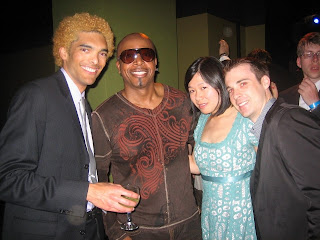 On the upside I got to see Rob, Neville, and Janette. And MC Hammer, of course. Neville invited me as his second guest (his +2) to a pretty cool Facebook party at the Metreon. I think 80% of Facebook employees are younger than I am. For some reason, MC Hammer was at the party as a guest. We got a picture, natch.
My next trip to the US is only a month away, for Armen’s wedding. Unfortunately I’ll have to fly coach. I’ve been spoiled by business class and I dread the downgrade. But it’s gonna be a lot of fun and I’ll get to see even more friends.
The visitor visas are only valid for 60 days, and do not technically allow one to work, so I am in the process of obtaining an employment license (EL). This visa requires a Z visa, a special single-entry visa for the purpose of obtaining an EL. The Z visa is much difficult to obtain, requiring formal company sponsorship, a health exam certified by a doctor in Beijing (including ECG, chest X-ray, and full bloodwork), etc.
Further, due to the tight controls surrounding the Olympics, the process of obtaining a Z visa has gotten more difficult. Previously you could get one at any consulate outside of China, including Hong Kong. They changed this rule the week I arrived in Beijing; now you can only get one from the consulate in your country of origin. This means a flight back to the US for the sole purpose of getting a visa to fly to China.
I did this this weekend. From the time I left Beijing to when I returned was 90 hours. Of those 90 hours, 38 were spent in transit, eg, in taxis, airports, and planes. It was one of the strangest and most absurd trips I’ve taken. It’s hard to believe all the money and other resources that went into satisfying one stupid rule.
 On the upside I got to see Rob, Neville, and Janette. And MC Hammer, of course. Neville invited me as his second guest (his +2) to a pretty cool Facebook party at the Metreon. I think 80% of Facebook employees are younger than I am. For some reason, MC Hammer was at the party as a guest. We got a picture, natch.
My next trip to the US is only a month away, for Armen’s wedding. Unfortunately I’ll have to fly coach. I’ve been spoiled by business class and I dread the downgrade. But it’s gonna be a lot of fun and I’ll get to see even more friends.
Friday, May 2, 2008
Money

China is very much a cash culture. Some shops, restaurants and bars take credit cards, but many do not. Chinese currency doesn’t come in denominations larger than 100 (about USD$14, probably because of fear of counterfeiting). Furthermore, many small retailers and taxis complain when you try to pay for a small item with a 100RMB note, so you have to constantly aim to keep a variety of denominations at your disposal. All denominations 1RMB and over feature a portrait of Mao, naturally. The nearly worthless Jiao (10 Jiao = 1RMB), colloquially called a “Mao,” does not feature Mao (obviously).
I’ve been told that a trip to a bank is a harrowing experience, so I have so far only gotten cash from ATMs. ATMs frequently run out of money on the weekends. Often times when I arrive at work, I see people in military fatigues with machine guns and spiked clubs (really) re-filling the ATMs in the lobby. Most uniformed officers are not very intimidating, but the dude with the spiked club is pretty scary.
Hong Kong Dollars are minted by private banks such as HSBC, and are significantly more colorful than RMB. Both currencies are sized based on the denomination, which makes a lot of sense to me.
I’ve been told that a trip to a bank is a harrowing experience, so I have so far only gotten cash from ATMs. ATMs frequently run out of money on the weekends. Often times when I arrive at work, I see people in military fatigues with machine guns and spiked clubs (really) re-filling the ATMs in the lobby. Most uniformed officers are not very intimidating, but the dude with the spiked club is pretty scary.
Hong Kong Dollars are minted by private banks such as HSBC, and are significantly more colorful than RMB. Both currencies are sized based on the denomination, which makes a lot of sense to me.
Monday, April 28, 2008
Hong Kong (and Macau)

I acquired eight new stamps on my passport in the past few days, passing through passport control in China, Hong Kong, and Macau. Although both HK and Macau are territories of China, they have a special autonomy and for the purposes of travel are considered international. Faizal also discovered that I have a talent for picking good customs lines: every time we chose a line, I got through faster by a significant margin. Possibly this is luck, but I like to think that I am able to weigh a lot of subtle variables, such as the composition of foreigners in a line, the number of children, and proximity to nearby resident-only lines which are often repurposed for visitors if no residents are waiting.
Macau is an interesting place historically, and if I had more time I would have liked to see more of the colonial history. But we only had a few hours to visit, which I spent watching Faizal bungee jump off of the Macau tower (the highest jump in the world) and roaming around the MGM and the Wynn. I wanted to see the Venetian, but I did zero research so I didn’t realize that it is not near the other hotels. Macau is not much like Vegas except for the décor of the hotels. Whereas Vegas has people from all walks of life eating, drinking, partying, and gambling, the big hotels in Macau are patronized by wealthy Asians who want to spend their time and money purely on gambling.
I don’t know whether it was the abundance of well-dressed girls or the fact that on every escalator (and there are innumerable escalators) people would stand to the left and pass to the right, but Hong Kong is a wonderful city. The British influence is apparent everywhere: clean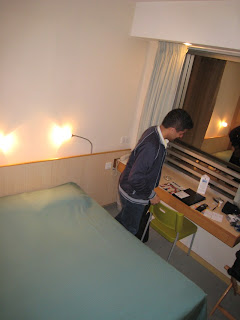 and efficient subways, polite manners, sharp dress, excellent signage, and driving on the wrong side of the road. Also, English is widely understood, which is a nice bonus. All this helped to offset the tininess of our accommodations: a mere 130 sq ft hotel room for both Faizal and I (pictured).
I think my favorite thing about HK was how easy it is to get around the city. The subway (MTR) is amazingly extensive, clean, very fast and operates on a very frequent schedule. We waited in most cases about 30-60 seconds to catch a train. Even more amazing was the fact that there is enough space of the subway that you can actually occasionally find a seat.
It’s hard to explain exactly, but the main thing I learned from visiting Hong Kong is that Beijing is still very rough around the edges. In Hong Kong I got a taste of what Beijing has the potential to become (on a much larger scale), but probably never will. That’s not a bad thing at all; in fact, it makes for good adventure.
Macau is an interesting place historically, and if I had more time I would have liked to see more of the colonial history. But we only had a few hours to visit, which I spent watching Faizal bungee jump off of the Macau tower (the highest jump in the world) and roaming around the MGM and the Wynn. I wanted to see the Venetian, but I did zero research so I didn’t realize that it is not near the other hotels. Macau is not much like Vegas except for the décor of the hotels. Whereas Vegas has people from all walks of life eating, drinking, partying, and gambling, the big hotels in Macau are patronized by wealthy Asians who want to spend their time and money purely on gambling.
I don’t know whether it was the abundance of well-dressed girls or the fact that on every escalator (and there are innumerable escalators) people would stand to the left and pass to the right, but Hong Kong is a wonderful city. The British influence is apparent everywhere: clean
 and efficient subways, polite manners, sharp dress, excellent signage, and driving on the wrong side of the road. Also, English is widely understood, which is a nice bonus. All this helped to offset the tininess of our accommodations: a mere 130 sq ft hotel room for both Faizal and I (pictured).
I think my favorite thing about HK was how easy it is to get around the city. The subway (MTR) is amazingly extensive, clean, very fast and operates on a very frequent schedule. We waited in most cases about 30-60 seconds to catch a train. Even more amazing was the fact that there is enough space of the subway that you can actually occasionally find a seat.
It’s hard to explain exactly, but the main thing I learned from visiting Hong Kong is that Beijing is still very rough around the edges. In Hong Kong I got a taste of what Beijing has the potential to become (on a much larger scale), but probably never will. That’s not a bad thing at all; in fact, it makes for good adventure.
Saturday, April 19, 2008
Negotiations

Much of daily business is conducted differently in China. Most retail transactions require an order of magnitude more discussion to complete. Ordering food usually involves a discussion with the waiter about the various items on the menu. Purchasing anything of value requires bargaining, which most Americans are not comfortable with. Bargaining (when I do it) goes something like this:
· Retailer points out several items I’m not interested in.
· I see something I like, retailer comments on how nice it is
· If it is an article of clothing, I try it on, and we debate about how well it fits
· If I want to purchase it, I ask how much money it is.
· Retailer pulls out a calculator, shows me an absurd price, clears it, and shows about 60% of that price, implying it is already discounted hugely.
· I quote a number (in Mandarin) less than half of the lower price
· Retailer says this is impossible, comes down slightly
· Repeat x3
· If I’m not at a price I’m comfortable with, I walk away (at which point they may run after me to resume the process)
· Once we arrive at a price, I am complimented on speaking Mandarin (though all I can really do is say the numbers, and “too expensive”), and told to bring my friends back
I’m never quite sure about what price to expect, generally you can get 2/3 or 1/2 of the initial price, depending on the place and product. Others are much better bargaining than me, but fortunately the sums are pretty small anyway.
Another example of complex transactions is our recent purchase of flights to Hong Kong. Anna spent several hours on the phone to arrange the tickets. Because they are international, everything is more complicated. In order to pay, the transaction had to be created and then individual forms sent to me, Anna, and Faizal to fill out credit card information. Then these forms had to be faxed, along with a copy of the passport biopage and both sides of the credit card. Then, a person comes by the office to deliver the ticket confirmation in person, to each of us individually.
It certainly does create jobs …
I actually have to return to the US in a few weeks for the sole purpose of getting a different visa. But it’s not fair for me to complain about the Chinese visa process; from everything I hear from my international colleagues living in the US, the US has the most complicated, lengthy, and frustrating process. So I guess I’m lucky!
· Retailer points out several items I’m not interested in.
· I see something I like, retailer comments on how nice it is
· If it is an article of clothing, I try it on, and we debate about how well it fits
· If I want to purchase it, I ask how much money it is.
· Retailer pulls out a calculator, shows me an absurd price, clears it, and shows about 60% of that price, implying it is already discounted hugely.
· I quote a number (in Mandarin) less than half of the lower price
· Retailer says this is impossible, comes down slightly
· Repeat x3
· If I’m not at a price I’m comfortable with, I walk away (at which point they may run after me to resume the process)
· Once we arrive at a price, I am complimented on speaking Mandarin (though all I can really do is say the numbers, and “too expensive”), and told to bring my friends back
I’m never quite sure about what price to expect, generally you can get 2/3 or 1/2 of the initial price, depending on the place and product. Others are much better bargaining than me, but fortunately the sums are pretty small anyway.
Another example of complex transactions is our recent purchase of flights to Hong Kong. Anna spent several hours on the phone to arrange the tickets. Because they are international, everything is more complicated. In order to pay, the transaction had to be created and then individual forms sent to me, Anna, and Faizal to fill out credit card information. Then these forms had to be faxed, along with a copy of the passport biopage and both sides of the credit card. Then, a person comes by the office to deliver the ticket confirmation in person, to each of us individually.
It certainly does create jobs …
I actually have to return to the US in a few weeks for the sole purpose of getting a different visa. But it’s not fair for me to complain about the Chinese visa process; from everything I hear from my international colleagues living in the US, the US has the most complicated, lengthy, and frustrating process. So I guess I’m lucky!
Saturday, April 12, 2008
Chinese Taxis
There is nothing quite like riding in a taxi in Asia. For me there is no other option. I live in Chaoyang on the eastern third ring road and work in Haidian, in the northwest. Without any traffic this would mean a reasonable 20-minute commute. But this is China, and even though most people cannot afford a car, there are too many for the roads to handle, so the traffic is brutal. I leave for work between 8am and 9am, and a typical ride in to work takes 40 minutes and costs about 40 kuai (kuai is a colloquial term for RMB, the Chinese currency. 7RMB = 1USD). The return trip is about the same, making my normal commute almost an hour and a half. Although subways exist, a line going from my apartment to work is still under construction, to be completed by June 30. This will save me money (the subway costs 2 kuai) but not time. Taking the bus is not an attractive option; it is even slower. So, I commute by taxi.
Fortunately this time is not completely wasted. I am learning Mandarin through the Pimsleur audio program (and now a private tutor as well), a kind of "listen and repeat" thing. The wonderful Seattle Library system has these rather expensive discs available for free, which I ripped and loaded on to my iPod. Each morning while commuting, I do a lesson. This no doubt drives the taxi drivers mad. As soon as I start responding to the voice only I can hear in barely intellibigle Chinese, they usually turn up the radio to drown me out. I also listen to the Economist in audio edition, usually on the way home.
Getting a taxi in Beijing is not a problem in most areas. Probably 20-30% of all vehicles are taxis. Finding a taxi becomes difficult when it rains, and sometimes during peak hours it can take more than 5 minutes to find an empty taxi. The meter drop is 10 kuai, which gets you 1km. Most of the places I want to go from my apartment are a 10-15 kuai ride.
Communicating with taxi drivers can be challenging. They do not speak a word of English (nor do I expect them to), so foreigners have two options: look like an idiot and get around showing business cards with your intended destination, or learn to speak enough to direct them around. My first priority language-wise was to be able to get around without the use of cards.
I learned that taxi drivers do not really understand adresses, nor do they know road names. Navigation is done by landmark; you describe your destination relative to a well-known location. For me that is Zhaolong Fandian, a hotel about a block away from my apartment. My current repetoire of phrases is:
Fortunately this time is not completely wasted. I am learning Mandarin through the Pimsleur audio program (and now a private tutor as well), a kind of "listen and repeat" thing. The wonderful Seattle Library system has these rather expensive discs available for free, which I ripped and loaded on to my iPod. Each morning while commuting, I do a lesson. This no doubt drives the taxi drivers mad. As soon as I start responding to the voice only I can hear in barely intellibigle Chinese, they usually turn up the radio to drown me out. I also listen to the Economist in audio edition, usually on the way home.
Getting a taxi in Beijing is not a problem in most areas. Probably 20-30% of all vehicles are taxis. Finding a taxi becomes difficult when it rains, and sometimes during peak hours it can take more than 5 minutes to find an empty taxi. The meter drop is 10 kuai, which gets you 1km. Most of the places I want to go from my apartment are a 10-15 kuai ride.
Communicating with taxi drivers can be challenging. They do not speak a word of English (nor do I expect them to), so foreigners have two options: look like an idiot and get around showing business cards with your intended destination, or learn to speak enough to direct them around. My first priority language-wise was to be able to get around without the use of cards.
I learned that taxi drivers do not really understand adresses, nor do they know road names. Navigation is done by landmark; you describe your destination relative to a well-known location. For me that is Zhaolong Fandian, a hotel about a block away from my apartment. My current repetoire of phrases is:
- I want to go to a place near Zhaolong Fandian, to the south
- Not this exit, the next one (they always want to exit at the wrong place)
- Go strait, turn left, turn right
- Here is OK
This is enough to get by, but I've asked my tutor to prepare a lesson on directions so I can learn to tell them distances, etc., and maybe even understand when they ask me questions about the route.
Now, as anyone who has travelled to the less-developed areas of Asia surely knows, riding in a taxi consists of constant lane changes, frequent honking, and reckless disregard for lane markers. There really is no way to describe the experience sufficiently. You just have to experience it, and accept it.
And of course, there are no seat belts.
The bizarre thing is that the seat buckles in the rear seem to have been removed intentionally. The belts are in place, but there is nothing to buckle them in to. I can't fathom why this is, but this is China. The front seats do have seatbelts, but these do not always work (a taxi driver in Xi'An was greatly amused when Eugene tried to use the dusty, unusuable belt and subsequently apologized for the act of trying to buckle himself in, as this implied the taxi driver was not a safe driver, which was of course true). Fortuntely (in a way) most of the time the taxi is not travelling nearly fast enough to be a dangerous. At night time though, things move pretty fast on the ring road, so I always take the front seat so that I get a belt, even if I'm the only one riding.
I look forward to the subway Line 10 becoming operational. Not because it will be much better; it will merely be a different sort of massive inconvenience. But at least it will be an alternative, and leave me with more beer money.
Subscribe to:
Comments (Atom)